
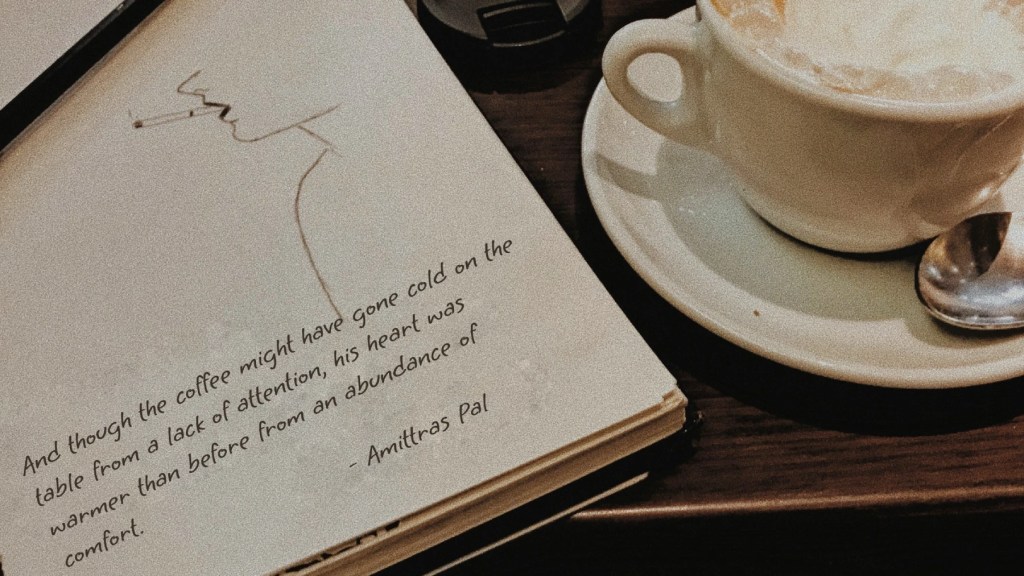
“Have you ever felt like you’re not enough?” Adi asked, trying to keep the tremor in check that threatened to break his words into babbling nothingness. His coffee was mostly untouched, the large saucer-like cup looking unnatural atop its tiny coaster. The coffee shop was the same one where he had spent many afternoons trying to write things in his journal, but failing to follow a plot of his choosing. His words took dark turns, his rhythm broke. Just like how right now, he felt that it was a tremendous challenge trying to finish that question.
“What do you mean?” Pragya asked, turning to him, pulling her eyes away from the little bouncing head of a little girl she was watching with intrigued curiosity, or at least Adi thought she was. Adi wondered what she was thinking, probably about what compels parents to choose such hairstyles for their kids. Of course, it looks cute in a feline sort of way, but other than making every kid look like one of those plump, dumpling-looking kids you see everywhere on Instagram, what did it achieve? Of course, individuality was the one thing that was being killed in pursuit of affection.
Pragya was weird like that, relating everything back to monotony. And so, Adi’s question didn’t immediately register. After all, what did it mean by not feeling enough?
“Have you ever felt like you’re not enough?” Adi repeated, pronouncing every word with more deliberation. This time, he was much more able to keep the hesitant crackle away from his voice. As if the last time he spoke was somehow a rehearsal.
“Why do you ask?” Adi watched Pragya carefully put the coffee cup down on the table. “Or rather, what do you mean by not enough? Not enough what? Not good enough? Not successful enough? Not happy enough?” She added an extra inflexion on the last part.
“In general, all of them, none of them, I don’t really know.” Adi said, clearly struggling with the challenge of narrowing the problem statement. He took a second to stare at the disappearing froth from the top of his coffee, and felt as if the little popping bubbles were his words, disappearing from existence, losing their meaning. “You know, just the idea of being enough. Like you have probably done enough to be alive. Or you’re right in choosing something over another thing, or that your thoughts matter enough.”
Adi could sense her confusion. But she did articulate it for his benefit, “I still don’t quite understand you, to be honest.”
Adi looked away, his eyes gazing at the passers-by milling all around them. As if a simplified version could materialise in the patterns of moving people. Of course, that was nothing more than chaos theory in action, no answers there.
“Okay, let me try to rephrase,” he turned back to her, seemingly giving up on relying on the world around, “do you ever feel like no matter what you do, right from waking up, to surviving the day to going back to bed at night, nothing is quite right, that there’s a mistake in everything, like something is always going to be off about whatever—”
The loud shriek of the little girl with the mushroom head snapped him from his monologue. They both turned just as she broke into a wail, complaining about the popsicle breaking off from the stick and falling onto the pavement. Adi laughed, “That’s kind of exactly what I mean, like you can’t really be careful enough, something will always happen to ruin things. Like you wake up, do something that you feel was important, only to realize that you could have used the time better on something else. Or maybe you do something that’s actually quite important, but then you realize that what you’ve done was fundamentally flawed.”
Adi let Pragya take all that in with focused contemplation. She was silent for so long, in fact, that Adi was fairly certain that he had lost her in the middle of the first sentence, and she simply didn’t want to call him a word-freak who can’t simplify anything for a normal conversation. Adi thought about adding something else, but then he decided she’s going to say something soon and doesn’t require any more input from him at the moment.
He took this opportunity to tear open one of the sachets of sugar the waitress had brought to put in his coffee. A dread passed his mind as he realised that he may already have put one sachet into the cup. Trying not to be obvious, he looked around for a torn sachet around the table and around his feet, but he found only one, which Pragya must have used. The constant internal conflict had successfully flared its ugly head once more.
But just as he was going to take a sip, Pragya spoke up, “Let me ask you something that might be a little difficult to answer.” Pragya said after what felt as if the eternal silence of all time and space had been crammed into one fleeting moment.
“Go ahead.”
“When you say that things are not quite right, or that something is off, what do you use to judge this?”
“What do you mean?”
“I mean, how do you define wrongness or the usefulness of an activity? What is creating the criteria that tells you that you’ve made a mistake or your work was not worthwhile?” Pragya paused. Adi was eager to answer within that little pause. He always did this when faced with a question like this, answering too early, without thinking. But that impulse left as soon as it came. Adi was thinking, and he was actually thinking hard about what she had asked.
Adi had held back that impulse on purpose. For the first time in a long time, longer than he was comfortable admitting, he was actually thinking about something before speaking out a half-formed thought that his mind had put together haphazardly. He let the coffee shop disappear around him; he let the wailing child be carried away by her mother to the nearest ice cream shop for another popsicle. And he let the coffee in front of him lose another few hundred minuscule froth bubbles.
He could almost sense Pragya judging the dark shadow that passed over his face. He had made a realisation, some epiphany that he didn’t actually like, and definitely couldn’t articulate if asked to do so simply.
“It’s just not the normal way things should happen.” Adi began, “Like, people normally do some things in certain ways, and that’s the right way to do those things, behave in those situations. Sometimes, the way I do those things, it’s simply not right. I mean, you are supposed to ask ‘are you alright’ when something falls from the overhead compartment on your partner. And you’re supposed to close the toilet seat before flushing so the splash doesn’t come out. Or you’re supposed to change before leaving the house to go out and again after coming back.” He had to pause again to take a breath. He also took a sip from his cup, the first since it had been brought. It tasted strangely too sweet, even with the bitterness clouding his mind.
“All these things,” Adi said, releasing a sigh, “are things that are supposed to be ingrained, not forced.” As if remembering something, he continued, “what I mean to say is, what if I do things in a flow and that flow is simply not right?”
“Look Adi, society’s accepted norms about some things may be right, like you should spend two minutes brushing your teeth, and all that you said, but not everything falls into that category. You’re right! You just do certain things on a flow, a flow that makes sense to you, a flow that feels natural to you.” Pragya said, paused for a breath, then continued. “But that’s not exactly what you had been thinking before saying this, were you?”
“I was!”
“You weren’t! You are simply denying the fact that you’re trying to change yourself based on something that tells you that you’re wrong. You may be wrong, but if you try to adjust every nook and corner of your being based on things coming from outside all at once, it’s like you’re casting yourself into the mould of normalcy made by someone else. And I don’t think that’s going to help.”
Adi took a sharp breath. He was amazed, scared even, of the way Pragya always seemed to understand exactly what he was thinking. He wished he could do it for himself sometime. It was true that he was trying to do things the right way because she didn’t approve of how he did things. Because she pointed out and expressed disapproval of his ways. “But what if that mould is the only thing that defines my life?”
“Does it though?” Pragya retorted, “does it really have to be that way? I mean, look at this coffee in front of you, if I were to think about how your dad used to make it because that’s how you learned to love the taste of coffee, what’s the point of this coffee shop? What’s the point of trying out different flavours, or infusing orange zest in it for that matter? Not that I approve of that, mind you!”
“But, what else is there if I’m just going to live for myself?” Even with the high pitch, it sounded hollow even to himself. It was again the conflict. He wanted it to be true, but he knew it wasn’t.
“Oh!” Pragya could finally decipher what he was thinking about. Adi couldn’t have phrased it clearly even if he wanted to. His analogy-finding mind, as Pragya knew, could never say things the way they were.
“You want it to be true because you feel like if you can’t fit into this definition of normalcy she made, you’d lose something that you feel is the only achievement in your life, you feel like you’d lose her. But why is it that she always has to be right? Why can’t you have an identity of your own? Why do you have to feel that she is a mistake that you need to punish yourself for…” The brief pause Pragya took seemed to stretch hours. It was both profound and simple at the same time. But the conflict inside Adi won’t accept it just like that. After all, Pragya was attacking the only thing he held dear, no matter how much he doubted himself.
“How can you call her a mistake?” Adi stammered. Suddenly, the aroma of coffee around him felt like the stench of a morgue, and the chatter that had become a subdued rustling became the thunder of a battlefield. “And what if I do think that she’s right all the time? I’m trying to make a life where she’s comfortable.”
“Look Adi, she isn’t the mistake, and neither are your actions. Of course you want to build a life for her, around her. But losing yourself in the process, one little action at a time, isn’t the right way, and doubting yourself for all this is definitely not the right way either. What’s wrong is fueling this fire that you hope would rebuild you into the way she wants.” Pragya kept her voice steady, like she always did. She was the calm one, something that Adi could never find within himself.
When he got up from the chair he was sitting on that afternoon, looking at the diary in his hand, the diary he had named Pragya so long ago because the name meant “deep wisdom”, he felt how fitting it was. A whole afternoon, with the diary and a pen that didn’t write anything, made him look at things in a way he had been refusing. And though the coffee might have gone cold on the table from a lack of attention, his heart was warmer than before, for an abundance of comfort.
Adi smirked, thinking about all that he had come to understand, but also about why he couldn’t finish the coffee. Two sachets of sugar, maybe the conflict and doubt could have that little win over him this afternoon.
 The Pilfered Diaries
Leave your thoughts